Our ambition
Laser Delta works toward three concrete goals, directly linked to the strategic challenges Europe faces in secure space communications. As a path of action for the Draghi and Wennink reports, these goals require collaboration across industry, research and government, and public-private commitment to translate ambition into action.
- Creating independence of non-EU infrastructure
- Reinvigorating the EU supplier base by developing optical user terminals
- Preparing to face new cybersecurity challenges through quantum key distribution
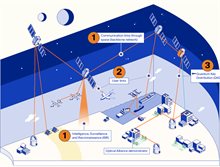
1. Creating independence of non-EU infrastructure through a sovereign satellite constellation
Building on existing experience in satellite development, the ecosystem is working toward a contribution to a sovereign integrated satellite constellation, interoperable with IRIS² and the Space Development Agency (SDA) constellation. Such a constellation would combine intelligence, surveillance and reconnaissance (ISR) capabilities with optical communication payloads, enabling sovereign access to secure communications and contributing to European GOVSATCOM pooling. Also upscaling the recent work by the Optical Alliance initiative and recent public-private collaboration initiatives in the Netherlands.
2. Reinvigorating the EU supplier base by developing optical user terminals
Optical user terminals — the devices connecting end users to the space optical backbone network — are not yet available on a commercial scale. Only a few companies with proven flight heritage are working on this technology, creating an inherent supply chain risk and a strategic opportunity for European industry. The ecosystem is positioned to develop optical terminal capabilities for military aircraft, naval ships and third-party satellites, building on existing strengths in maritime manufacturing, aerospace systems and photonic integrated circuit (PIC) technology.
3. Preparing to face new cybersecurity challenges through quantum key distribution
Quantum computers are expected to break conventional cryptography within the foreseeable future, requiring fundamentally new approaches to securing communications. The ecosystem is working toward engagement in the space segment of EuroQCI — the EU's continent-wide quantum communication infrastructure — through the development of a first quantum key distribution (QKD) ground station in the Netherlands that will be built and tested in ESA's Eagle-1 programme, and investment in a sovereign knowledge base on space-enabled QKD developments. This builds on quantum research capabilities already present within the ecosystem, including investments through QDNL and NXTGEN Hightech.