
The challenge for Europe
Secure space communications are crucial for timely decision-making, offering resilience, flexibility and global coverage that terrestrial communications cannot provide. Europe currently depends on foreign infrastructure — including the Advanced Extremely High Frequency and Wideband Global Satcom systems — for critical communications.
To ensure that Europe and its member states retain adequate access to secure space communications end-to-end in the future, the following challenges should be addressed.
- Overdependence on non-EU infrastructure
- A threatened European supplier base (industrial and service)
- Disruption of cybersecurity standards and governmental intelligence
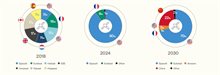
Graph shows the decaying capabilities for Europe in a growing market through the distribution of optical in-orbit satellite counts by country, based on information available from public sources, verified where possible. Especially for China, verifying the information has been challenging. The percentages should be regarded as indicative. While this graph only shows hardware, it is important also to appreciate the market for services (payloads, data processing, etc.) correlating with it.
Overdependence on non-EU infrastructure
Most European countries, including the Netherlands, rely on excellent NATO military communications infrastructure as well as access to European national capabilities through bilateral agreements. Alongside that, European-led sovereign communications infrastructure is needed to ensure availability in times of geopolitical fragility and conflict, to avoid priority denial on bandwidth and to gain better control of resources. This is in line with the Netherlands Defence Space Agenda, which calls for more European and national resources, and the Long-Term Space Agenda, which calls for adequate sovereign access to information facilitated by optical satellite communications.
A threatened European supplier base (industrial and service)
Europe's supplier base, serving both commercial and governmental needs, is being dramatically challenged at all stages of the value chain by the emergence of a US and privately-led dominance — Starlink today, reinforced by Kuiper tomorrow. For both sovereignty and economic prosperity, the European supplier base needs reinvigoration. Recent initiatives including the European Defence Industrial Strategy and European Defence Industrial Programme reflect the urgency of strengthening European technological and industrial capacity in the space domain.
Disruption of cybersecurity standards and governmental intelligence
Quantum computers are anticipated to become able to break conventional cryptography within the foreseeable future. New encryption methods will therefore be required. Currently, countries like China and Russia are leading the technological race in space-based quantum secure communications. Europe has responded with initiatives including IRIS² and EuroQCI — but industry and governments must act now to develop the capabilities needed to deliver on these programmes.
The opportunity
These three challenges represent an equal number of opportunities for European industry and governments to act together. Laser Delta exists to connect the organizations with the capabilities to respond, and to speak with one voice toward International, European and Dutch stakeholders.